|
|
 |
|
**List: Danish Ministry Bible ( Bibelen )
DANISH. [CHRISTIANIA.]--1860 S. Bagster [Info only: Gothic Character "1848" John 1:1-14 unknown.] |
Dansk / Danish Bible History (3)
**List: Danish Ministry
Bible ( Bibelen )
Danish...
"III.--VERSIONS OF THE SCRIPTURES IN THIS LANGUAGE. The earliest translation of any portion of the Scriptures into Danish is contained in a MS. pre-
served in the Royal Library of Copenhagen, supposed to have been written in the thirteenth, or
In 1515, Pedersen, who is said to have
beginning of the fourteenth, century. It is a servile imitation of the Vulgate, and defective in several
parts; it proceeds no farther than the Second Book of Kings.
been the first Lutheran clergyman in Zealand, published at Paris a Danish version of the Gospels and
Epistles appointed to be read in churches: this work was reprinted at Leipsic in 1518.
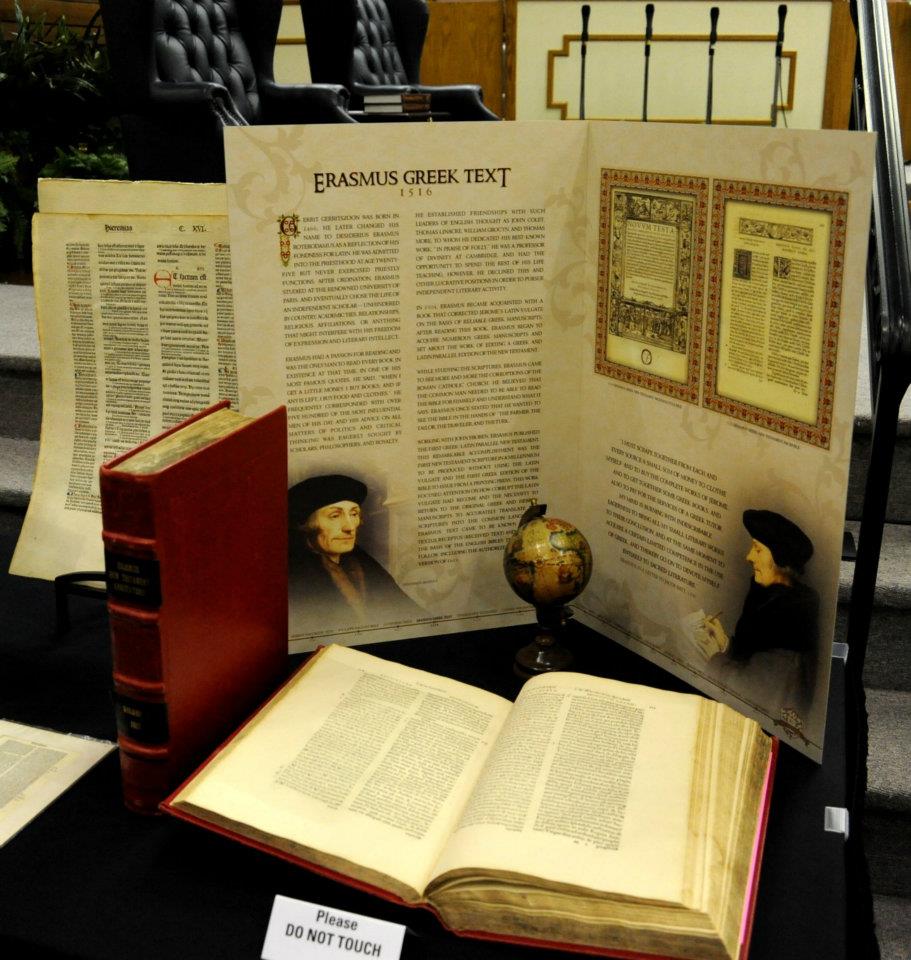
The first Danish version of the whole New Testament was made by Hans Mikkelsen, sometimes
called John Michaelis. It was published at Leipsic in 1524, and reprinted at Antwerp in 1529.
This version was executed by the command, and under the immediate patronage of Christian II.; "a
monarch," says Dr. Henderson, "whose character earlier writers have depicted in the blackest colours,
but whom posterity, though not blind to his faults, seems on the whole inclined to favour." Like
our Henry VIII., he seems to have been actuated less by zeal for the progress of truth than by the
desire of freeing his kingdom from the domination and tyranny of Rome. During a rebellion in
Denmark, he fled for safety to Holland, and it was during his state of expatriation that he promoted
the translation and publication of the New Testament. Hans Mikkelsen, the translator, was originally
mayor of Malmoe, in Scania, or Southern Sweden, and afterwards secretary to Christian II.; he volun-
tarily forsook his country, his connections and interests, and accompanied his sovereign into exile.
When compelled at length, by the resentment of the Catholics of the Netherlands, to quit his royal
patron, he retired to Harderwick, in Guelderland, where he died about eight years after his New
Testament had left the press.
This version professes to be "properly translated according to the Latin;" but Dr. Henderson has
shown that this designation in all probability applied only to the first part of the work, which con-
tained the Four Gospels, and in which the Latin version of Erasmus was followed. In the Acts, and
remainder of the New Testament, Mikkelsen has followed the German version of Luther so closely,
that his translation is little else than a verbal transmutation of Luther's. Some writers have attempted
to account for this circumstance by suggesting that Mikkelsen had probably commenced his translation
before Luther's version had appeared; but that when he came to the Epistles, the first edition of
Luther's version having then been published, he preferred the version of the faithful and intrepid
reformer to that of the timid and indecisive Erasmus. The language in which Mikkelsen wrote is
partly Danish and partly Swedish, resembling the dialect still spoken in his native district of Scania,
in the south of Sweden. He has arranged the books of his New Testament in the same order as in
that of Luther, and the Epistle to the Hebrews, and those of St. James and St. Jude, are placed
after the rest, on account of the doubt then entertained by the reformers as to their authenticity.
In 1528, two versions of the Danish Psalms were published: the one at Rostock (by Francis
Wormord, originally a Carmelite friar, but who afterwards espoused the principles of the Reformation,
and became bishop of Lund), and the other at Antwerp, by Pedersen, who has been already mentioned
as the translator of the Gospels and Epistles of the church service. In his version of the Psalms,
Pedersen appears to have translated both from the Hebrew text and from Jerome's translation: his
diction is considered too paraphrastic, and too much accommodated to Christian sentiments; yet the
style is remarkably pure for the age in which it was written, and an admirable preface on the beauty
of the Psalms enhances the value of the work. It was reprinted in 1531, and again in 1584 and 1586
at Copenhagen.
In 1529, Pedersen translated and published the New Testament at Antwerp. This version was
executed on the basis of Mikkelsen's, but it is written in a superior style; foreign words and idioms
are excluded, and a better system of orthography is adopted. The Epistle to the Hebrews here finds
its proper place, but the Epistle of St. James is found last in order, as in Luther's version. Pedersen,
however, had obtained clearer views as to the real value and importance of the Epistle of St. James than
his predecessors, for he expresses his disapprobation of the irreverent manner in which Luther and
Mikkelsen had spoken of it. This version obtained so wide a circulation that Pedersen republished it
at Antwerp, with the Psalms, in 1531.In 1535, some progress was made toward the production of a Danish version of the Old Testa-
ment, by the publication of the Pentateuch at Magdeburg, translated by Hans Tausen, afterwards
bishop of Ripen. This version was made from the Hebrew text, with constant reference to the
Vulgate and to Luther's version: it was so well received that a second edition was printed at the same
place in the following year. The book of Judges, translated by Peter Tideman, a clergyman of
Zealand, was published at Copenhagen in 1539: it sometimes follows the Vulgate, and sometimes
Luther's version.
It was not till 1550 that the whole Bible was published in Danish. Denmark was indebted for
this treasure to her monarch Christian III. The translation was undertaken at the suggestion of
Bugenhagius, the celebrated reformer, who had been invited to the court of Copenhagen to assist in
the correction of ecclesiastical abuses. The execution of the work was committed to the theological
faculty at Copenhagen, then consisting of Peter Palladius, Olave Chrysostom, John Synning, and
John Macchabœus, or Macalpine. Tideman, the translator of the book of Judges, was also engaged
in it; and Pedersen, the translator of the Psalms and of the New Testament above mentioned, was
employed in writing out a fair copy from the several translations which were made by those appointed
to the work. The version was made from that of Luther, and follows it closely, except in a few
instances, in which the translators have mistaken the meaning of the German. The first edition con-
sisted of 3000 copies of the entire Bible, and, to meet the expense, a tax of two rix-dollars was levied
on every church in Denmark. A separate edition of the New Testament of this version in 4to. was
published at Wittenburg, with some slight orthographical corrections. Le Long speaks of another
translation of the New Testament having been made by Jonas Turreson, at Copenhagen, in 1584, but
Dr. Henderson expressly states that no such translation is known in Denmark.
A revision of the entire version was undertaken in 1586, by the command of Frederic II. That
monarch wrote to the rector, professors, and others of the University of Copenhagen, ordering them,
"with the assistance of three of the Copenhagen preachers, to read through the version of the Bible,
which had been made in the reign of his royal father; to collate it with the Hebrew text; and where
any defect was found, or any passage in which the true sense had not been expressed, to amend and
correct it." The heads of the university appointed the most learned divines of the day to execute this
important undertaking. The New Testament was revised by Nicholas Hemmingius, D.D., whose name
is famous in the ecclesiastical history of Denmark for his attachment to the doctrines of Calvin. The
revision of the entire Scriptures was not brought to a close till 1589, when an edition was issued in
folio at Copenhagen, with Luther's notes.
Two editions of the Psalms, from the version of Palladius, were published at Copenhagen in 1591
and 1598; and, in 1599, an edition of the Psalms, in German and Danish, was published in 8vo. at
Lubeck. Early in the following century some more extensive measures were taken for the spread of
the divine word. An edition of the New Testament was issued at Copenhagen in 1604, printed from
the former text, as a temporary supply; and a royal letter was, at the same time, addressed to the rector
of the university on the subject of obtaining a more correct impression. The king, Christian IV.,
eventually appointed Dr. Resen, bishop of Zealand, to superintend a fresh revision of the Scriptures.
The old version was again collated with the original texts, and several European translations were con-
sulted; but Dr. Resen considering the version of Luther too free and paraphrastic, fell into the opposite
error, and followed the originals too literally, without sufficiently considering the genius and properties
of his own language. The New Testament was published in two volumes, 18mo., in 1605: an edition
of the Pentateuch, also in 18mo., was published the same year; and, in 1607, the entire Bible was
completed at press in 8vo. These editions were printed at Copenhagen, at the expense of the king.
Several editions of the Psalms succeeded the publication of Resen's Bible; among which was one
at Copenhagen, in 8vo., 1614, and another in 1632, at the expense of the benevolent Lady Marsvin.
An edition of the entire Bible, printed from the revised text of 1589, was published in 1633 at
Copenhagen; and Le Long speaks of it as "the mater of other smaller editions in 8vo.; which theprinters from that time exposed for sale."
The expense of its publication was borne by means of a sum
levied from every church in Zealand and Norway.
In 1639, the royal permission was obtained for reprinting Resen's Bible, the former impression
being completely exhausted. This edition is designated "Swaning's Bible," because it was corrected
principally by Hans Swaning, archbishop of Zealand. The New Testament appeared in 1644, and
the entire Bible, in 1647, at Copenhagen. Another edition of this Bible was also published during the
same year, in six volumes 8vo.; followed by several editions of the Psalms, and, in 1670, by another
edition of the Bible in small 8vo. for common use.
A College of Missions was established at Copenhagen in 1714, and Denmark was indebted to
this institution for several successive editions of the Scriptures. The New Testament, from the edition
revised by Swaning, was issued from the mission press in 1716; followed in 1717 and 1720 by
editions of the entire Bible, also from Swaning's text. In the preface to a Bible printed by the college
in 1722, it is stated that, in the space of six years, 22,580 copies of the New Testament and 13,784
Bibles had been published at the mission press. In the fire which occurred at Copenhagen in 1728,
the mission press was destroyed, and the Orphan-house then obtained the exclusive privilege of printing
the Danish Bible; and several editions of the New Testament and of the entire Bible were published
by that institution between the years 1732 and 1745. In the meantime efforts were made to obtain a
more correct and faithful edition of the Scriptures than any that had yet appeared, and a specimen of
a revised edition was published in 1742, by the Committee of Revision appointed by royal authority.
In 1748, the Committee published a revised New Testament, but it is not believed that they corrected
any portion of the Old Testament.
About this period a specimen of a new and singular translation of the Scriptures was printed by
Schwartz, councillor of justice to his majesty, but he does not appear to have published further portions
of his translation. A translation of Habakkuk was given in 1752 by Monrad, a clergyman in
Aagerup; and in 1780 a new version of the Testament was printed at Copenhagen, translated by
Dr. Bastholm from the Greek, but marked by too servile an adherence to the idiom of the original.
Numerous other editions of the established text were printed at Copenhagen before the formation of
the Danish Bible Society.
The first edition of the Danish Scriptures, undertaken by the British and Foreign Bible Society,
was designed for the benefit of the Danish prisoners of war, of whom there were, in 1808, no less than
2782 in this country; and also for distribution in the Danish colonies in the East and West Indies.
This edition, which consisted of 5000 copies of the New Testament, was printed in 1810 in 12mo.,
from the Copenhagen edition of 1799; and the press was superintended by the Rev. W. F. Rosing,
minister of the Danish church in London. A second edition of 5000 copies of the New Testament, in
the same form, was published by the Society in 1814. In the course of the following year, another
revision of the Bible was commenced at Copenhagen by royal authority. Bishop Münter and five
learned professors were formed into a commission of revisal by his Danish majesty, and an edition of
10,000 New Testaments, corrected and revised by them, left the press in 1819. A second and stereo-
type edition, also of 10,000 copies, was printed under the authority of the king at the Orphan-house,
about 1820. The same royal commissioners continued their labours in a similar revision of the Old
Testament; and in the year 1824 appeared, under the same royal sanction, from the Orphan-house
press, a 4to. edition of the whole Bible. The revised New Testament on its first appearance was
received with general approbation, and was reported by Dr. Pinkerton and others to be "a faithful
and excellent version." The British and Foreign Bible Society, with its accustomed liberality,
granted several sums in aid of the publication; but this assistance was afterwards withheld, on its
being discovered that several exceptionable renderings and marginal notes had been admitted by
the revisors.
The committee of the Danish Bible Society, conjointly with the committee of the Norwegian
Bible Society in Christiania, have been engaged for several years past in the task of revising the DanishOld Testament. This work is advancing slowly under the care of Professor Hermansen. Up to the
year 1859, the total number of copies of the Scriptures issued by the Danish Bible Society, since its
formation in 1814, amounted to 259,983.
Greatly increased facilities for the circulation of the Protestant Bible in the kingdom of Denmark
have been opened within recent years, by an arrangement happily come to between the British and
Foreign Bible Society of London and the Orphan Institution at Copenhagen, which latter body
possesses by law the exclusive right to print the Scriptures within the Danish realm. Prior to 1855,
all editions of the Scriptures produced at the Copenhagen press were accompanied by the Apocrypha
and explanatory notes, and hence the Bible Society was by its rules precluded from taking any part
in their circulation. In that year, however, at the instance of the London Society, the directors of
the Orphan Institution agreed to produce the New Testament free from all notes and apocryphal
references. The concession thus happily obtained was at once acted on: an edition of 10,000 Danish
New Testaments was produced for the London Society under the auspices of the Copenhagen Orphan
Institution, and passed into rapid circulation. A subsequent edition of 5000 has been found neces-
sary to meet the demands made upon the Society's Agency, and is now (1859) completed.IV.--EDITIONS OF THE DANISH SCRIPTURES FOR NORWAY. Upon the incorporation of Norway with Sweden, a Norwegian Bible Society was formed at
Christiania in 1816, under the patronage of the king of Sweden; and, aided by a grant of £500 from
the British and Foreign Bible Society, an edition of 6000 New Testaments was printed in 1819, not
from the revised and exceptionable edition, but from the former authorised version of the Danish
Scriptures, which had been executed on the basis of Luther's. In 1820 farther assistance from London
was granted to the Norwegian Society; and another edition of 10,000 copies of the New Testament,
from the same text as the preceding, left the press at Christiania in 1823.
Representations having been laid before the British and Foreign Bible Society concerning the
scarcity of Bibles in Norway, an edition of 5000 copies was printed in London in 1823, from the
Christiania edition, under the editorship of the Rev. Mr. Treschow, a native of Norway. Another
issue, consisting also of 5,000 copies, was printed in 1827, Mr. Troilius correcting the press, and
the Rev. C. Rahm also reading the proof sheets. An edition of the entire Bible was published
by the Society in London in 1829: it consisted of 5000 Bibles, and about 10,000 additional
New Testaments, and was superintended by Mr. Rahm. The text selected was the authorised
version of 1644, or rather the reprint of 1744, generally considered the most correct edition that
had appeared.
The British and Foreign Bible Society established an agency of its own at Christiania about the
year 1827, for the purpose of printing and circulating the Danish Bible alone, without the addition of
the Apocryphal Books, which the continental Societies were in the habit of binding up with the
inspired volume. Several stereotype editions have been issued under the superintendence of this agency
on behalf of the British and Foreign Bible Society. The total number of copies published at the
expense of that Society, up to the end of 1859, is 50,848 Bibles, and 300,934 New Testaments, with
10,000 Psalms.
Similar agencies have also been established at Drontheim and at Stavanger (on the S.W. coast
of Norway), and at each of these places the work of distribution has for some years past been
actively carried on. The total number of issues, by the Society's agents in Norway, during the
year ending February 1860, amounted to 25,061, a considerable increase upon previous issues."--The Bible of Every Land. (1860, Second Edition) Samuel Bagster [Info only]DANISH. [CHRISTIANIA.]--1860 S. Bagster [Info only: Gothic Character "1848" John 1:1-14 unknown.]
[Christian Helps Ministry (USA)] [Christian Home Bible Course]